Solanum lycopersicum
Varieties
- Celebrity Plus
- Skyway
- Lemon Boy Plus
- San Marzano II
- Red Pearl | Supernova
- Maxifort or Multifort (rootstock for grafting)
- Blush
- Bigdena
- Napa Chardonay
- Amish Paste
- Oxheart
Growth Habit
Determinate | Indeterminate
Growing Conditions
Heat Tolerant | Greenhouse Performer } Tomahook | Florida Weave | Suitable for Hydroponic
Disease and Pest Notes
Pest Info
- Hornworms-Hand pick larvae. Populations are usually controlled naturally.
- Aphids can be washed off plants with a hard stream of water. They have several natural predators that control populations including parasites (aphids appear grey or bloated), lady beetle larvae and lacewings.
- Whiteflies- Check any purchased plants for signs before bringing them home. Eggs are laid on the underside of leaves in a crescent or circle. Insecticidal soap can help. Lady beetle larvae, lacewing, parasitic wasps and songbirds all feed on whiteflies. A hard freeze will also kill them.
- Colorado potato beetle (CPB) – While Bacillus thuringiensis var. tenenbrionis. is effective against CPB and was formerly the easiest insecticide to use, the current formulations have been removed from OMRI-A status due to difficulties with assessing inert ingredients. Luckily there is a new addition to the arsenal in the form of spinosad (such as Entrust™). Spinosad works rapidly and effectively against CPB, as well as against corn earworm, imported cabbage worm, codling moth, and several other difficult lepidopterous pests. Ideally we will regain access to Bt so that these two formulas can be used in rotation with one another to prevent selection of resistant insects. Crop rotation, control of solanaceous weeds, barrier trenches between old and new plantings, trap cropping, use of straw mulch or row cover can delay or reduce CPB pressure.
- Cutworms- Usually only a problem for young transplants, placing a collar around the stem when plants are set out will protect them.
- Flea beetles- Floating row cover can protect plants. Be sure to remove when temps are warmer than 85 degrees.
Disease Info
- The most problematic disease for tomato growers in the Northeast, Mid-Atlantic, and Midwest is early blight, caused by Alternaria solani and Alternaria alternata in cooperation with Septoria lycopersici. Early blight is best treated early with regular applications of fungicidal sprays such as oxidate and/or copper hydroxide.
- Field tomatoes are also subject to several common diseases that affect fruit quality, such as bacterial speck (Pseudomonas syringae pv. tomato) and anthracnose (Colletotrichum coccodes). Symptoms include black spots on the fruit; the size (less than 2 mm) distinguishes bacterial spec from bacterial canker and bacterial spot, two other bacterial diseases which case larger fruit spots. The best prevention for all bacterial diseases is to use disease-free seed and to avoid contact with plants during moist conditions.
- Bacterial canker (Clavibacter michiganensis subsp. michiganensis) has become more common in recent years with the increase in greenhouse tomato operations. The most distinctive symptom of are raised, light tan, “birds-eye” cankers, no more than 3 mm in size. Diseased plants should immediately be removed and destroyed to prevent spread. Most sprays are largely ineffective and can serve to spread the disease.
Mulch Type
Wood chips after planting
Propagation
Seed
Life cycle
Seed germination treatment details
Soak at 122°F in water for 25 minutes to control seedborne disease if issue.
Soil block size
3/4 inch for germination. Move to 4 inch blocks after first true leaf. Approx __ days to first true leaf.
Light requirements and depth
1/4" deep or pushed into surface with vermiculite cover.
Seed germination temperature
75° - 85°F, Minimum 50F
Heat mat temp
75°F - with plenty of light for 4 – 5 weeks. In last week before moving outdoors, reduce the temperature to 60 – 65°F or remove from heat mat.
Planting details
If you start your own or buy in grafted plants, I recommend giving them all, no matter what type or variety, no less than two feet of space.
REDDIT: Something that I don’t think gets mentioned enough regarding overnight temperatures is the importance of diurnal temperature. In the eastern half of the US, 45F at night probably means 65F during the day. Compare that to the west coast where 45F at night probably means 75F during the day.
If your daytime highs are warmer, the soil will absorb more heat during the day and won’t cool off as much at night. That means you can generally get away with cooler night temperatures in the western us than you can on the east coast.
https://njaes.rutgers.edu/FS1102/
DETERMINATE PRUNING
Determinate tomatoes need no pruning other than removing all suckers below the first flower cluster because pruning won’t affect their fruit size or plant vigor. If you do any pruning at all above the first flower cluster on determinate tomatoes, you’ll only be throwing away potential fruit.
This is sometimes referred to as pruning to the “fork” (see Figure 1B). Removing the sucker immediately below the first flower cluster on the main stem or pruning above this flower cluster can result in severe leaf curling and stunting of the plant and therefore should be avoided.
Proper stringing consists of tying the twine to an end stake, passing the string along one side of the plants, and looping the twine around each stake. When you reach the end of a row continue the same process on the other side of the row. The string must be kept very tight throughout the stringing process. The string tension must be tight enough to hold the plants upright and well trained, but if the string is too tight harvest can be difficult, and string scars or misshapen fruit may result. The first stringing should be done before the plants fall over usually about eight to ten inches above the ground on plants 12 to 15 inches tall (see Figure 3).
Sometimes, the first string consists of a figure eight between the two plants inside the stakes to prevent the plants from falling into each other.
Culture and fertilization requirements
It takes a solid week to 10 days of 70 to 80 degree daytime temperatures to warm the soil.
A good rule of thumb is to wait until night time temps stay in the 50 to 55 degree range before planting.
Medium-rich soil with pH 6.0–6.8 preferred. Fertilize accurately since excess nitrogen causes rampant growth, rot, and delayed ripening.
Succession interval - maximum
36 ( only for Determinate varieties )
Harvesting details
When To Harvest Heirloom Tomatoes
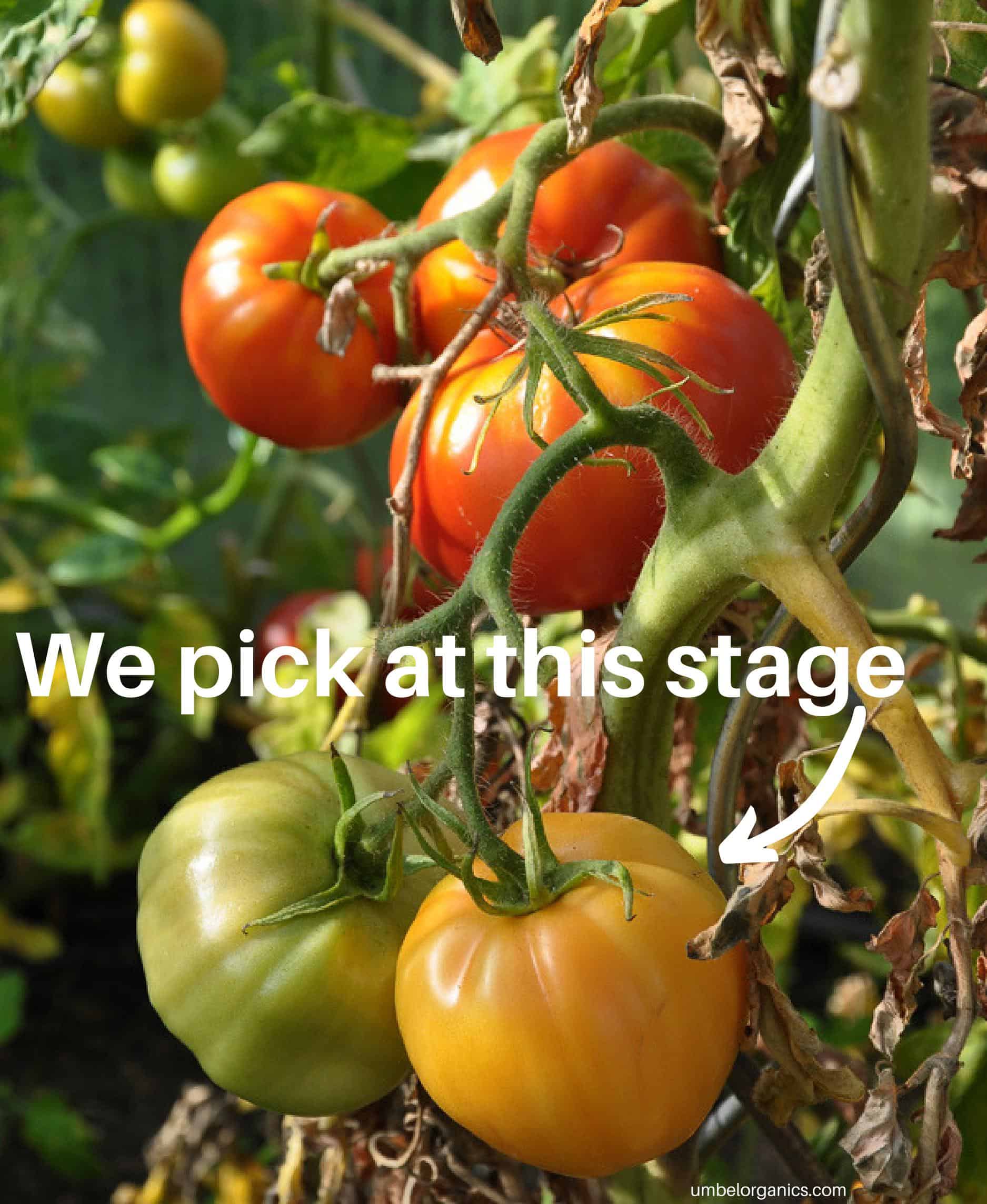 Most red slicing and beefsteak varieties are thought to be best when harvested at the “turning” or “pink” stage. This is when at least 50% ripened color is showing.
Cherry and grape tomatoes should be hatvested ripe. They will not continue to ripen well if picked early.
You should wait until Romas are completely red before harvesting for prime flavor.
Ethylene gas is produced by fully formed mature green tomatoes. Inside the mature green tomato, two growth hormones change and cause the production of the gas, which in turn ages the cells of the fruit, resulting in softening and loss of the green color, turning into a red shade. The ethylene increases the carotenoids (red and yellow colors) and decreases the chlorophyll (green color).
It is because of this process, tomatoes are one of the only vegetables which can be picked before they are completely ripened. Harvest time for tomatoes should ideally occur when the fruit is a mature green and then allowed to ripen off the vine. This prevents splitting or bruising and allows for a measure of control over the ripening process.
Tomatoes ripen from the bottom of the plant and the top of each “truss,” regardless of their variety.
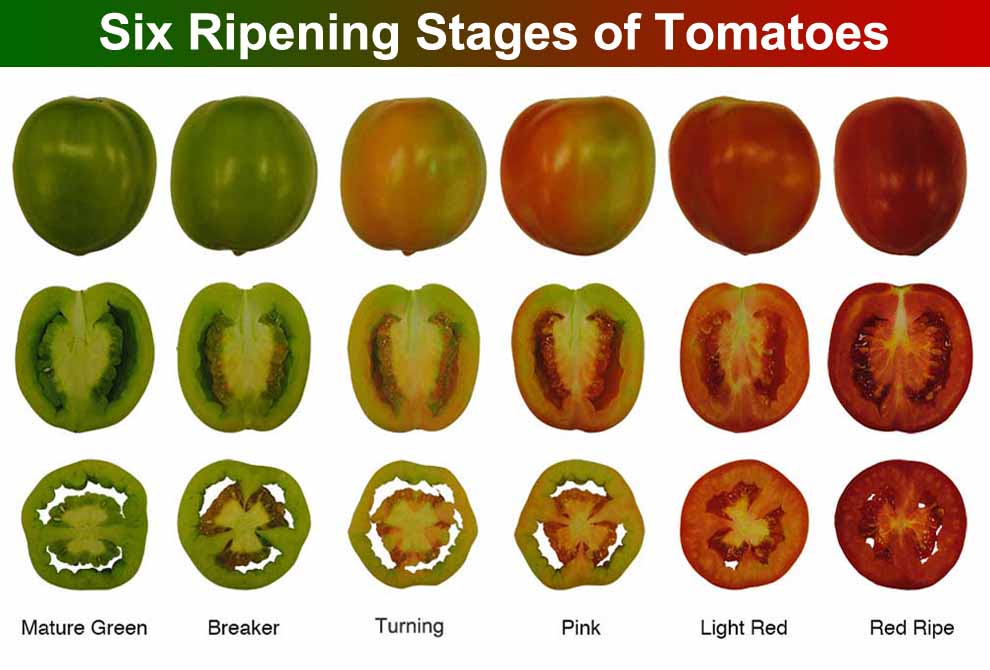
The 6 ripening stages of tomatoes are as follows:
- Mature Green
- Breaker Stage
- Turning
- Pink
- Light Red
- Ripe Red
Green, mature tomatoes stored at 65-70°F, will ripen in about 2 weeks. Cooler temperatures slow the ripening process. At 55°F, they will ripen in 3-4 weeks. Never expose tomatoes to temperatures below 50°F for more than a few days—the quality will suffer.
Six Ripening Stages of Tomatoes
1. Green Mature Stage
At this point in the fruit’s development, color will be visible inside the fruit but not yet visible on the outer skin. If the fruit is picked at this point of development, the flavor will not be fully developed.
2. Breaker Stage
In the Breaker Stage, color will be visible at the blossom-end of the tomato skin and tomatoes are considered to be “vine ripe.” The color change at the blossom end indicates the tomato is producing ethylene, a ripening agent produced by the plant.
It is also at the Breaker Stage that the tomato receives no additional nutrients from the plant. In fact, a skin will form between the plant stem and the plant, effectively cutting off nutrients from the plant to the fruit.
According to the above-referenced article, benefits of allowing the Breaker Stage tomatoes to ripen off the vine include:
- The tomato has a vine-ripened flavor (note here that sunlight is not a factor in fruit ripening).
- The tomato is not susceptible to cracking, due to excess moisture flowing into the fruit.
- Sunscald is not an issue.
- Additional insect damage is avoided.
3. Turning Stage
In this stage. between 10% and 30% of the tomato’s skin is pink, pinkish or red.
4. Pink Stage
In this stage, the coloration has spread to 30% but not exceeded 60% of the tomato skin. The fruit is also becoming a bit softer to the touch.
5. Light Red Stage
In the Light Red Stage, the coloration has spread to 60% but has not exceeded 90% of the tomato skin.
6. Red and Final Stage
Finally, at this point, 90% of the tomato has that classic red color and is ready to eat from the vine.
The question of whether or not a tomato is ready for harvest, continues to be a debate among many gardeners. From a strictly physiological perspective, tomatoes are ripe at the breaker stage; however, those tomatoes will not be sporting the classic red (or yellow, or orange) color. In addition, conventional wisdom is that a tomato is vine-ripened when it’s reached its full color.
It is important to remember that tomatoes continue to ripen even after they are picked. In fact, if weather stays very hot, above 85°F, then ripening slows or stops. To avoid storm damage and sunscald, it may behoove the gardener to actually ripen the fruit off the plant.
More info
Formation of the Abscission Zone (the AZ)

Visible AZ or knuckle on tomatoes
Current Seed Start & Transplant Dates
Note: Seed starting and transplant dates do not always correlate one to one with dates shown below. Note correct start and expected transplant dates on the tag of the tray for seed germination. Adjust dates with plant tags on a yearly basis if necessary. 8 ounces of fertilizer is about 1 cup. Consider Sustane various NPK and Alfalfa Meal or Blood Meal for nitrogen.
| Seed Start to Transplant Days |
42 |
| Days to Maturity after Transplant |
30 |
| Days to Maturity Total |
72 |
| Succession Interval |
48 - Determinate only |
| Number of Plantings per Season |
2 Spring |
| Number of Transplants per Plant Date |
1st 24 - 2nd 10 |
| Square Feet of Bed Space per Plant Date |
72 ( 48 on 2nd planting ) |
| Linear Feet of Bed Space per Plant Date |
40' ( 24' 1st and 16' 2nd ) |
| Spring Expected Harvest Date Range |
06/18 to 10/31 |
Athens
Franklin
Transplant Details: Transplant 24" spacing on center
Direct Sow Dates ( if any )
Direct Sow Details: 18 inches
Seed Saving
Polination Type
Self Pollinated
Seed Collection
Save seeds from: As many plants as possible.
Pick fruit very ripe - usually 6 to 8 weeks from fruit set.
Seed Viability Years
4 years
Seed Cleaning and Storage
Squeeze pulp and seeds from ripe fruit and add a small amount of water and let ferment for several days at or below 70º. Stir several times a day to speed fermentation which takes about 4 days. Non-viable seeds will float. Spread on paper or screen and let dry for a week or two.
Use silica gel packet in storage container placed in refrigerator
===
Tomato seeds are ripe when the fruits are ready to eat! Cut the fruit at the equator and squeeze or scrape out seeds from each of the cavities. In a cup or bucket, add a little water (1/2" is probably plenty) to your seeds and pulp to keep them from drying out, and allow them to ferment away from direct sunlight. Ideally, you will stir the concoction every day for 3-5 days. In the end, add more water to fill the vessel, stir one final time, and allow to settle. Pour off the floating material and then strain the seeds through a strainer. Sometimes, you will need to add more water and pour off the floating material several times until the water is clear and you can see the seeds sunken at the bottom. Squeeze dry the strained seeds in a towel, and then lay out to dry on a labeled screen or paper product in a ventilated place away from direct sunlight for a week or two.
Isolation Requirements
10 feet - or some say 35 - 50 feet to prevent flying insects from spreading pollen.
Variety Details
Variety Name
Celebrity Plus
Variety Description
Everything you love about the original Celebrity, now with enhanced disease resistance. TSWV resistance will help Southern growers, while the additional Fusarium and Stemphylium resistances are more broadly useful. Fruits avg. 7–9 oz. with more uniform shoulder ripening and better crack tolerance. Healthy plants. Vigorous determinate. High resistance to Alternaria stem canker, Fusarium crown and root rot, Fusarium wilt races 1–2, gray leaf spot (Stemphylium); and intermediate resistance to nematodes, tomato mosaic virus, tomato spotted wilt virus, and Verticillium wilt.
Growing Habit (variety)
Determinate
Seed Type
Hybrid
Seed Vendors
Johnnys - $4.95 30 seeds | $13.95 100 seeds
Variety Name
Skyway
Variety Description
Large, organic beefsteak-type with broad disease resistance for the South.
Attractive red, moderately ribbed 8-12 oz. tomatoes. Skyway's multiple resistances keep the vigorous plants healthy. Very good flavor and fruit quality. High resistance to Fusarium wilt races 1, 2, and 3, tomato apex necrosis virus, Verticillium wilt; and intermediate resistance to nematodes, tomato spotted wilt virus, and tomato yellow leaf curl virus.
Growing Habit (variety)
Determinate
Seed Type
Hybrid
Seed Vendors
Johnny's $14.85 - 50 seeds
Variety Name
Lemon Boy Plus
Variety Description
An updated version of the classic Lemon Boy tomato with added disease resistance and sweet, tangy flavor — a marked improvement over typical yellow tomatoes. The flattened-round, 7–8 oz. beefsteak fruits are consistent in size, shape, and quality with very few blemishes. A high-yielding variety with good firmness. Comprehensive disease package offers wide adaptability and keeps the plants healthy and the fruits clean. Can be harvested bright lemon-yellow to deeper golden-yellow when fruit exhibits light checking and a subtle blush at the blossom scar. Harvest a bit underripe if you prefer a more acidic flavor profile. High resistance to Alternaria stem canker, Fusarium crown and root rot, Fusarium wilt races 1–3, gray leaf spot, tomato mosaic virus, Verticillium wilt; and intermediate resistance to nematodes and leaf mold.
Growing Habit (variety)
Indeterminate
Seed Type
Hybrid
Seed Vendors
Johnny's 100 seeds $12.50
Variety Name
San Marzano II
Variety Description
High-quality strain of this classic heirloom paste tomato. San Marzano is considered one of the best paste tomatoes of all time, with old-world look and taste. Whole 4–6 oz. tomatoes peel easily and cook down quickly. Various strains of San Marzano exist; this strain was selected by tomato breeder Emily Rose Haga from seeds from the USDA gene bank, which is designed to preserve genetic diversity and increase food security. The strain originates from Parma, Italy, where it was developed for the 1950's canning industry. This strain has a very traditional San Marzano shape and appearance as well as a vibrant red color.
Growing Habit (variety)
Indeterminate
Seed Type
Open Pollinated
Seed Vendors
Johnnys $7.55 250 seeds
Variety Name
Red Pearl | Supernova
Variety Description
Tender and nearly seedless, with intermediate resistance to late blight.
Fruits weigh 15-20 gm., and have good flavor and a meaty texture. Resists cracking and stores well on and off the vine. Tall, healthy plants. Intermediate resistance to late blight.
Growing Habit (variety)
Indeterminate
Growing Conditions (variety)
Fertilize accurately since excess nitrogen causes rampant growth, rot, and delayed ripening.
Seed Type
Open Pollinated
Seed Vendors
Johnnys | Red Pearl - 100 seeds - $12 (pricey as this is one sale)
High Mowing | Supernova 35 seeds $3.25
Variety Name
Maxifort or Multifort (rootstock for grafting)
Variety Description
Vigorous, vegetative rootstock for large fruits and long-season cropping.
Grow tomato rootstock to add disease resistance and much improved plant vigor for an extended harvest. Maxifort adds a very high level of vigor. High resistance to Fusarium (races 1 and 2), Fusarium crown and root rot, nematodes, corky root rot, tomato mosaic virus, and Verticillium wilt. Disease resistance is not transferred to the scion plant. NOTE: Maxifort should be used for rootstock only. If left to grow on its own, the fruit produced is small, stays green, and is not good for consumption. Primed seed for improved germination. NOTE: With Maxifort, you may experience uneven germination in some conditions.
Growing Conditions (variety)
For more information on grafting with rootstock tomatoes, please refer to one of our production guides: Top Grafting Tomatoes or Side Grafting Tomatoes. Maxifort rootstock can lead to uneven germination in some conditions; if grafting to Maxifort, see our Maxifort production guide for tips on mitigating this issue. After cotyledons (first leaves) have expanded, fertilize with a complete nutrient solution (EC 1.0, pH 5.8) or equivalent as needed to keep plants dark green and healthy; increase EC as plants grow. Once the grafted plants have healed, continue by growing and managing the plants as you would normally. Grow plants at 66-68°F (19-20°C) day and night temperature. When transplanting into the greenhouse, maintain 73-77°F (23-25°C) day and night temperature for a few days after transplanting to promote rapid vegetative growth and root establishment. Once fruit begins to set, lower night temperature to 62-66°F (17-19°C) and keep a daytime temperature of 68-72°F (20-22°C).
Seed Type
Hybrid
Special Notes
To improve germination rate and uniformity, all of our tomato rootstock seeds are primed.
https://www.johnnyseeds.com/growers-library/methods-tools-supplies/grafting/maxifort-rootstock-tomato-germination-tech-sheet.html
We recommend avoiding heat mats with tomato rootstocks, as they can cause uneven heating and drying of the planting medium, especially when you are starting seeds very early in the season, when temperatures are likely to drop to a lower extreme.
K-State Video
https://www.youtube.com/watch?v=NWYgvyC5WDo
Seed Vendors
Johnny's | 50 seeds - $27.50
Paramount - Multifort 100 seeds - $29
https://paramountseeds.com/products/multifort-tomato-rootstock-pelleted-seed
Pest Notes (variety)
Buy a resistant rootstock of a F! variety and graft onto it instead of buying a specific Multifort or Maxifort seed.
http://tomatoville.com/showthread.php?t=50033
Paramount also has a seed called Estamino that is an excellent root stock for fusarium and NPK without being quite as vegetative. I now almost exclusively use RST-04-106-T from NE seeds because along with great fusarium and nematode tolerance it is the only root stock that I know of that helps with Bacterial Wilt which is a major concern down south. It also seems to work better with more different varieties for me than the Multifort or Estamino. It seemed to me that every root stock variety I have tried there are a few scion varieties that just don't thrive on that particular root stock and that is true of the RST root stock also. If you find a variety of scion that isn't doing well after the graft either in its production or plant growth try grafting it onto a couple of other root stocks and see how it does.
Variety Name
Blush
Variety Description
Sweet, fruity flavor has universal appeal. Beautiful, bright yellow snacking tomato. Red stripes appear as blossom-end red marbling develops. Strong plants tolerate tough conditions. Great in mixes with the other Artisan tomatoes. 25-30 gm. fruits.
Seed Type
OP
Seed Vendors
Johnnys - 40 seeds | $5
Variety Name
Bigdena
Variety Description
Greenhouse tomato - Recommended by Gwen for greenhouse growing BuildASoil YouTube.
Seed Vendors
Johnnys 15 seeds $10. $1 per seed for larger orders elsewhere so this is just pricey.
Variety Name
Napa Chardonay
Variety Description
65-70 days. Yellow mutation from Napa Rosé Blush, Brad says this one has “a super-amazing flavor,” with many who tasted it for the first time proclaiming it the very best cherry type they had ever tasted. Also, this variety is very easy to grow and does especially well in containers.
Seed Vendors
Rare Seeds $4
https://www.rareseeds.com/tomato-napa-chardonnay-blush
Variety Name
Amish Paste
Variety Description
Supposedly less susceptible to Blossom End Rot than San Marzano.
Variety Name
Oxheart
Variety Description
The Oxheart is smooth, thick, tender and almost seedless; frequently showing two inches thick without a seed cavity. The color is pink and it has that delicious mild flavor that every lover of this fruit likes so well. Rich soil adds greatly to its productiveness. Late variety.
Growing Habit (variety)
Indeterminate